Continuous Threat Exposure Management (CTEM) is a proactive cybersecurity framework designed to systematically and iteratively identify, assess, prioritize, and mitigate potential threats and vulnerabilities within an organization's digital infrastructure. Unlike traditional vulnerability management approaches that often rely on periodic assessments, CTEM emphasizes continuous monitoring and improvement, ensuring that security measures evolve in tandem with emerging threats.
The CTEM Cycle
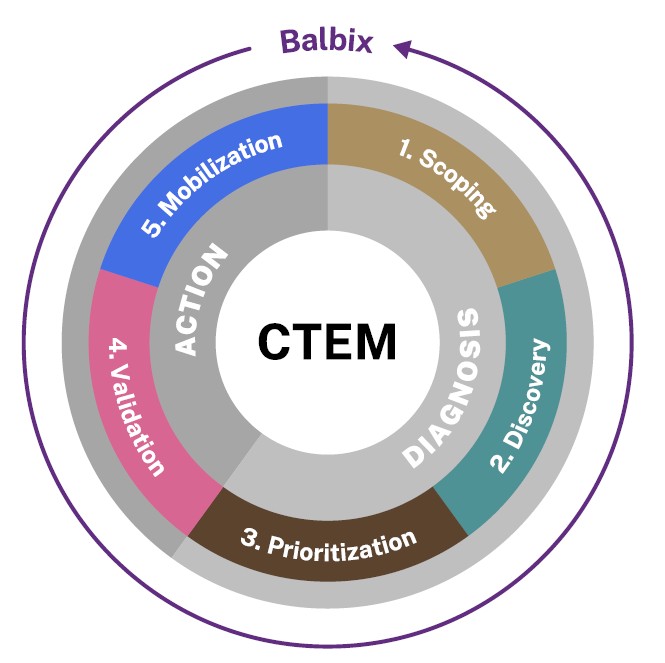
Step 1: Scoping
In implementing a continuous threat exposure management program, we begin with scoping. This critical first step requires us to define our attack surface comprehensively, looking beyond traditional infrastructure. We must understand that our attack surface isn't limited to just servers and endpoints, but extends to everything that could provide an entry point for attackers. This includes our cloud assets, SaaS applications, supply chain connections, social media presence, and code repositories. During scoping, we need to make strategic decisions about where to focus our initial efforts. The key is to avoid the common pitfall of trying to boil the ocean - instead, we need to scope based on business risk and potential impact, creating a manageable starting point for our continuous threat exposure management journey.
Operational Implementation
These are the related functions in the Balbix Platform:
Data Aggregator Deployment
Step 2: Discovery
The discovery phase builds upon our initial scoping, but goes much deeper. During discovery, we systematically identify both visible and hidden assets, finding not just the obvious systems and applications, but also discovering shadow IT, forgotten assets, and unknown dependencies. We look for vulnerabilities, misconfigurations, and other types of security weaknesses across our defined scope. But here's a crucial point: success in discovery isn't measured by how many assets or vulnerabilities we find. Instead, we need to understand what we're discovering in the context of business risk and potential impact. This means going beyond simple asset counting to understand relationships between assets, their business purpose, and their role in critical processes. Discovery must be continuous, as our technology landscape constantly changes with new deployments, decommissioned systems, and ongoing reconfigurations.
Operational Implementation
These are the related functions in the Balbix Platform:
Set owners for predefined groups
Create user-defined groups and assign owners
Configure asset and apps automations
Configure asset and apps dashboards
Also review the following technical reference articles:
Unified Enterprise Asset Classification Model
Consolidating Operating Systems and Software: A Unified Approach
Understanding Data Lifecycle in Balbix
Step 3: Prioritization
Prioritization moves us beyond merely identifying issues to making informed decisions about what to fix first. We must recognize that we can't fix every security issue immediately, so we need sophisticated prioritization that considers multiple factors. How urgent is the issue? What security controls do we already have in place? What's our tolerance for residual risk? Most importantly, what level of risk does each issue pose to our high-value business assets? This isn't just about technical severity scores. Instead, we need to understand the full context: is this vulnerability on a critical business system? Is it exposed to the internet? Do we have evidence of active exploitation? By answering these questions, we can focus our limited remediation resources where they'll have the greatest impact on reducing business risk. This context-aware prioritization ensures we're not just fixing vulnerabilities, we're systematically reducing our most significant exposures.
Operational Implementation
These are the related functions in the Balbix Platform:
Hierarchy-Based Reports
Also review the following technical reference articles:
Understanding Mean Time to Patch (MTTP)
Understanding Mean Time to Remediate (MTTR)
Understanding Mean Open Vulnerability Age (MOVA)
Using the Exposure Score Simulator
Balbix Exposure Simulator Use Cases
Step 4: Validation
The validation phase is where we move from theoretical risk to practical reality. Here, we verify our assumptions about security issues by understanding how real attacks might unfold. Could an attacker actually exploit this vulnerability given our current security controls? What are all the possible attack paths to reach our critical assets? Are our incident response plans adequate for the types of attacks we might face? Validation isn't just a technical exercise, it requires alignment with business stakeholders to agree on what triggers remediation actions. We need to understand not just if an attack is possible, but how it might impact business operations, what our detection capabilities are, and whether our response would be fast enough to prevent significant damage. This validation process helps us refine our prioritization and ensures we're focusing on real, exploitable risks rather than theoretical vulnerabilities.
Operational Implementation
These are the related functions in the Balbix Platform:
Step 5: Mobilization
The mobilization phase of continuous threat exposure management is where planning transforms into action. While automated remediation has its place, particularly for straightforward issues, successful mobilization requires coordinating people, processes, and technology. We need to break down complex remediation tasks into manageable projects, assign clear ownership, and establish metrics to track progress. Security findings must be translated into actionable tasks for system owners, with clear communication about risk context and remediation priorities. We need efficient workflows that remove obstacles to remediation, streamline approval processes, and enable quick deployment of fixes. Documentation of these workflows is crucial, especially when remediation requires coordination across multiple teams. The goal isn't just to fix individual issues, but to create sustainable processes for continuous risk reduction. Effective mobilization turns our security insights into measurable risk reduction, moving us from identifying problems to actually solving them.
Operational Implementation
These are the related functions in the Balbix Platform: